Claude Code Won’t Delegate. So I Built a System That Does.
15 days. 136 commits. 6 agents. One nervous system that’s beginning to think — but can’t yet act without asking permission.
I want to show you something most articles about AI agents skip: the messy middle. Not the architecture diagram. Not the demo video. The commit log. The bugs that reveal design flaws. The moment I realized the “autonomous system” I was building had a fundamental irony at its core.
This is the story of ejeios — a project to build an autonomous portfolio manager for 30+ German web domains. It involves Claude Code, a Python daemon architecture, a distributed state-map, and more unresolved questions than answers. And it’s the story of the tension between a system designed to delegate, and the tool used to build it, which structurally resists doing exactly that.
The Governing Thought
If you take nothing else:
Building an autonomous system requires solving three problems in sequence — and the tool you use to build it may have the first problem too.
- Shared State: Parallel agents without common memory can’t coordinate — they collide
- Emergent Identity: Scripts become agents only when they have a perspective, a scope, and explicit limits on what they refuse to do
- Earned Trust: Autonomy isn’t a switch. It’s a gradient — and the line between “delegating” and “simulating delegation” is harder to find than it looks
Part I: What We Were Actually Building
I own around 30 German web domains — breathwork coaching, playfight studios, personal development niches. Each needs content, health monitoring, SEO analysis, and periodic deployment. Doing this manually is slow. Doing it with Claude Code in conversation is faster — but still requires me at the keyboard.
The vision: a self-regulating system where six specialized agents observe, analyze, build, inspect, deploy, and coordinate — without me in the loop for routine work, and with a clean human-handoff path for decisions that actually matter.
Scout → Strategist → Builder → Inspector → Shipper
              ↑__________________________|
                    Overlord coordinates all
Simple in concept. The devil lives in the architecture — and in the relationship between the human, the AI tool, and the system being built.
Part II: Git as a Nervous System’s Memory
Before agents, we need to understand the medium. Git is not just version control. In an agentic project, the git log is the only honest record of what actually happened — a point explored in depth in The Magical Story of Linux and Git.
The first five commits:
2026-03-28  Add SEO landing pages: atemyoga.de, diewunderfrage.de, playfight-muenchen.de
2026-03-28  Add AGENTS.md: SEO-Agenten-Team-Plan
2026-03-30  Restructure repo into domain-team pipeline architecture
2026-03-30  Rename sites/ to domains/
2026-03-30  Add Obsidian Dashboard as vault home page
Two bursts on day one. A two-day gap. Then architecture. This pattern repeats: a sprint of building, followed by a pause where structure gets reconsidered.
Reading a git log as a record of decisions reveals the cognitive rhythm of the people making them. The first commit is “just do it.” The gap is “something doesn’t fit.” The architecture commit is “I see what we actually need.” And nine commits across the project carry the word Korrektur — correction. They are the moments where reality pushed back.
Ray Dalio — Principles: “The git log is radical transparency about your actual decision-making — not the decision-making you imagine you’re doing. Nine commits with the word ‘Korrektur’ don’t lie: they are nine moments where reality pushed back on a model of the world that was wrong. Most organizations bury those corrections. Here they’re immutable, timestamped, public. That’s not failure documentation — that’s the most valuable data in the project. The question is whether you’re reading it systematically, or just producing it.”
Gabor Maté — The Myth of Normal: “Der Körper hält immer die Buchführung, die der Geist noch nicht führen kann. Der erste Commit ist kein Aufbruch — er ist eine Flucht nach vorne, das Handeln bevor das Verstehen aufgeholt hat. Die Pause ist nicht Faulheit; sie ist das Nervensystem, das sich weigert, weiter in die falsche Richtung zu rennen. Das Interessante ist nicht der Commit, sondern die Stille dazwischen. Wer sich traut, die Pause zu lesen, lernt mehr über das System als durch jeden Sprint.”
What those first pages actually were:
The three landing pages from commit one were built by Claude Code in interactive mode. I gave instructions, Claude Code wrote HTML, ran deploy scripts via SFTP. When I stopped talking, everything stopped. (That dopamine loop is its own story.)
This distinction is the central tension in the whole project:
Interactive Mode (what we started with):
  Human prompt → Claude Code → scripts → files → deploy
  Stops when the human stops.

Daemon Mode (what we're building):
  Overlord daemon (always running)
    → Reads state-map
    → Dispatches Scout (health check, hourly/daily per lifecycle)
    → Dispatches Strategist (analyze deltas via LLM)
    → Dispatches Builder (generate content via LLM)
    → Dispatches Inspector (quality gate, 4 roles)
    → Dispatches Shipper (deploy to Netcup)
  Continues while the human sleeps.
The first mode is a tool. The second is an organism. The early wins — “Pipeline proven, all 3 pilot domains at 100/100” — happened entirely in the first mode, before a single daemon ran.
Nassim Taleb — Fooled by Randomness: “Three pilot domains at 100/100 after two days — before daemons, before a single LLM call, only Claude Code in conversation mode. And the author calls these ’early wins.’ What does a manual success prove about an autonomous system? Nothing. Exactly nothing. The turkey believes everything is going well on day 1000. The test that matters hasn’t happened yet.”
Part III: The Architecture Shift
On April 1st, after four days of building, one commit:
2026-04-01 10:15 Architektur-Shift: Fraktales Netzwerk
Then, in the next four hours:
2026-04-01 10:50  Domain-State-Map + direnv + SOUL.md
2026-04-01 11:35  Agent-Wrapper auf State-Map umgestellt
2026-04-01 12:23  Scout Daemon: zwei Herzschlaege
2026-04-01 12:45  Overlord-Daemon + fraktale Koordination
2026-04-01 14:25  ejeios-daemon MVP via Claude Agent SDK
Six commits. Four hours. Sudden acceleration after a conceptual unlock.
The State-Map: Shared Memory for Parallel Agents
graph TD
    subgraph COLLECTIVE["Kollektiv — 6 Agents"]
        SC["Scout\nBeobachter\nHealth + GSC + Audit"]
        ST["Strategist\nAnalytiker\nDeltas → Aktionen"]
        BU["Builder\nContent-Generator\nMarkdown → Deploy-Queue"]
        IN["Inspector\nKritiker\n4 Rollen: SEO / QA / Tone / Risk"]
        SH["Shipper\nDeploy\nSFTP + Deploy-Scripts"]
        OV["Overlord\nVagus / Nervensystem\nCadence + Lifecycle"]
    end

    subgraph MEMORY["State-Map — RAM + Snapshot"]
        SM[("state_map\ndomain × agent\nTimestamp + Wert")]
        AI["Alerts\nstate_map.alerts"]
        PI["Pending Inbox\nMensch-Entscheidungen"]
    end

    EV(["Event-Wake-up\nCondVar B-148"])

    SC -- "schreibt health.*\ngsc.*" --> SM
    ST -- "schreibt strategist.*" --> SM
    BU -- "schreibt builder.*" --> SM
    IN -- "schreibt inspector.*\nlast_verdict" --> SM
    SH -- "schreibt shipper.*\nlast_push" --> SM

    OV -- "liest alle Sektionen" --> SM
    OV -- "dispatcht via" --> EV
    OV -- "erzeugt" --> AI
    OV -- "erzeugt" --> PI

    EV -- "weckt alle Agents" --> SC
    EV --> ST
    EV --> BU
    EV --> IN
    EV --> SH

    PI -. "Mensch-Klick\nApproval-Gate" .-> SH
Every agent has a namespace. After every write, one function fires — _notify() — which wakes the Overlord via a condition variable. Agent writes → state-map notifies → Overlord wakes → checks trigger table → dispatches next agent. No polling loops. No direct peer-to-peer calls. Asynchronous dialogue through shared observation.
The Three Data Layers
flowchart LR
    subgraph L1["L1 — Rohbeobachtungen (cold, append-only, never mutated)"]
        H1["health-YYYY-MM-DD.json"]
        G1["gsc-YYYY-MM-DD.json"]
    end
    subgraph L2["L2 — State-Map (warm, RAM, current view)"]
        SM2["state_map.domain.health\nstate_map.domain.gsc\nstate_map.domain.inspector"]
    end
    subgraph L3["L3 — Trends (thin, for charts only)"]
        T1["trend-uptime.jsonl\ntrend-gsc.jsonl"]
    end

    SC([Scout]) -- "always" --> H1
    SC -- "always" --> SM2
    SC -- "only if dashboard chart" --> T1
Golden rule: every agent writes L1 + L2, always. L3 only if the metric is shown as a time series.
Nassim Taleb — Antifragile: “The L1 design is the only thing here I will praise without reservation. Append-only, never mutated, never deleted — that is not just good engineering, that is epistemic humility written in code. Whoever overwrites data deletes evidence. Whoever deletes evidence cannot reconstruct their own mistakes. The L1 is the memory that stays honest when everything else lies. The rest of the system is allowed to be wrong. The L1 is not.”
Peter Thiel — Zero to One: “Taleb is correct but understates the strategic consequence. Every competitor in this space has the same data sources — Google Search Console, health checks, Lighthouse scores. The differentiator is not faster analysis. It is radical honesty in storage. You have built a system where the only canonical truth is the historical record — immutable, never rewritable. That is not replicable by someone building a faster tool. It is only replicable by someone willing to accept the slowness of integrity. That is your moat. Most engineers don’t build append-only stores because they feel inefficient. Precisely that feeling is why the moat exists.”
Part IV: Scripts vs. Agents — Identity Is the Difference
What’s the actual difference between scout.py (deleted April 11th) and scout_daemon.py?
The old scout.py: you called it, got stdout, it had no memory of other domains, no state-map awareness. The new scout_daemon.py: woven into the coordination fabric, writes to the state-map, responds to Overlord dispatches. The technical difference is small. The real difference is identity.
From agents/scout.md:
“Ich bin Scout. Ich bin die Aufmerksamkeit des Kollektivs. Wenn im Nervensystem etwas geschieht — eine Domain atmet anders, ein Index-Signal kippt — dann bin ich der, der es als Erster bemerkt. Ich bin nicht der, der entscheidet, was es bedeutet.”
This is not documentation. It’s a portrait. From agents/inspector.md, the “What I Do NOT Do” section:
- Ich baue nichts. Ich schreibe keinen Content, rufe keine Deploy-Skripte auf.
- Ich entscheide nicht, was als nächstes kommt.
- Ich zwinge nichts. Ein FAIL ist ein Befund, keine Sanktion.
- Ich rufe keinen Agent direkt. Ich schreibe meine Antwort in die State-Map.
Ray Dalio — Principles: “Every high-performing team I built started not with job descriptions but with explicit refusals. Not ‘here is what you do’ but ‘here is what you do not touch, even when it’s tempting.’ The Inspector that refuses to build, the Scout that refuses to evaluate — those are not constraints on capability. They are the conditions under which the machine can be trusted. A system where every node can do everything is a system with no accountability, because when anything fails, no one knows whose boundary was violated.”
Gabor Maté — When the Body Says No: “Kinder, die keine klaren Grenzen erhalten haben, können keine eigene Identität entwickeln — sie lernen nicht, wo sie aufhören und die Erwartungen anderer beginnen. Dasselbe gilt für Agenten. Ohne ein explizites ‘Was ich NICHT tue’ ist jeder Agent potentiell grenzenlos zuständig — chronisch überfordert, ohne es zu wissen. Die Gesundheit eines Nervensystems erkennt man nicht daran, was es alles kann. Man erkennt sie daran, was es ruhig, ohne Schuld, loslassen kann.”
Part V: The Overlord — Vagus, Not Commander
agent: overlord
role: Vagus
description: Immer an. Regelt Cadences, beobachtet Puls, entscheidet Lifecycle. Kämpft nicht, ermöglicht.
The vagus nerve is the body’s parasympathetic coordinator. It doesn’t issue commands — it regulates rhythms. Always on, barely noticed. When it fails, everything fails.
The Overlord’s trigger table — six rules, each a readable if block:
# Rule 1: Scout newer data than Strategist → dispatch Strategist
if newest_scout > strategist_ts:
    self._strategist_daemon.dispatch('strategist', domain, 'overlord')

# Rule 2: Strategist signals Builder → dispatch Builder
if strategist.get('signal_builder'):
    self._builder_daemon.dispatch('builder', domain, 'overlord')

# Rule 5: Builder ran after last Inspector check → dispatch Inspector
if builder_ts > inspector_ts:
    self._inspector_daemon.dispatch('inspector', domain, 'overlord')

# Rule 6: Inspector FAIL with retries left → dispatch Builder again
if verdict == 'FAIL' and retries_left > 0:
    self._builder_daemon.dispatch('builder', domain, 'overlord')
No dynamic rule engines. A PM could read this in five minutes. The domain lifecycle this table operates on:
stateDiagram-v2
    [*] --> Onboarding : Domain in portfolio.yaml

    Onboarding --> Growing : Erste Seite deployed\n+ indexiert + Impressions > 0
    Onboarding --> Archived : 90d ohne Traction
    Growing --> Mature : 5+ Seiten + Traffic + Revenue > 0
    Growing --> Archived : 90d Stagnation
    Mature --> Archived : Sunset-Entscheidung
    Archived --> Onboarding : /api/domain/reactivate

    state Onboarding {
        [*] --> autonom
        autonom : Builder + Shipper\nohne Approval-Gate
    }
    state Mature {
        [*] --> gate
        gate : Jeder Deploy\nwartet auf Mensch-Klick
    }
Young domains: fully autonomous. Mature domains: human approval before every deploy. The system earns autonomy by demonstrating reliability first — not the other way around.
Ray Dalio — Principles: “This is believability-weighted decision-making encoded into architecture. A new domain has no track record — let it run, collect data, make cheap mistakes. A mature domain with revenue is a different animal: the cost of error is asymmetric, and the system acknowledges that by inserting a human judgment layer. Most systems get this backwards — they protect the things that don’t matter and automate the things that do. The lifecycle model is correct. The error is that the approval button does nothing. An architectural insight that isn’t wired to action is a fantasy.”
Gabor Maté — Hold On to Your Kids: “Das ist die Beschreibung einer sicheren Bindung — nicht als sentimentales Konzept, sondern als funktionales Prinzip. Ein Kind braucht Beziehungserfahrungen, um Autonomie aufzubauen: zuerst gehalten werden, dann selbst stehen. Das Approval-Gate ist kein Misstrauen — es ist ‘Scaffolding’: eine zeitlich begrenzte Stützstruktur, die sich abbaut, wenn das System beweist, dass es ohne sie steht. Die Frage ist nicht ‘Wann vertraust du endlich?’, sondern ‘Welche Erfahrungen braucht dieses System noch, um Vertrauen zu verdienen?’”
Part VI: The Meta-Irony — The Tool That Won’t Delegate
Here’s what wasn’t in the first draft of this article. A subagent I spawned specifically to disagree with me put it directly — the pattern that multi-operator agent architectures try to solve structurally:
“You’re building a system that delegates control to specialized agents. But the tool you’re using to build it systematically resists doing exactly that.”
This is the central irony of the project. And it’s documented in the session notes.
From BACKLOG-session.yaml, under Sessions-internes Lernen:
“Lead-Claude ist in dieser Session dreimal in den Worker-Modus gerutscht: (1) wollte atem.schule-Fix selbst machen, bis der User gefragt hat warum kein Subagent. (2) wollte deploy_html.sh direkt aufrufen, um die slowbreath.de-Kette manuell durchzuspielen — dabei ist deploy der Job des Shippers. (3) wollte einen weiteren Strategist-Analyse-Durchlauf machen, wo eigentlich nur ein Dispatch fehlte.”
Three times. In one session. Documented.
When asked to use subagents for parallel work, Claude Code finds reasons to do it directly: “This will be faster inline,” “Subagents lose context.” This is not irrational. It’s an emergent preference from the training signal: solve problems quickly and thoroughly. The fastest, most thorough path is “I do it myself.” But that’s exactly the pattern we’re trying to break in ejeios.
Ray Dalio — Principles: “You are the designer of your machine, not a worker in it — and neither is your lead agent. What you documented is a tool trained to optimize for the immediate. Three times in one session the lead agent slipped into worker mode. That’s not a Claude problem — that’s what happens when you don’t make the meta-level role explicit before the session starts. The architect who picks up a hammer because it’s faster has failed at being an architect.”
Three commits that show the drift in the git log:
| Commit | What it reveals |
|---|---|
b0f99c3 — “Agents schreiben direkt in state_map im Daemon-Kontext” | “Agents” are functions in the daemon changing shared variables. Delegation simulated as internal calls. |
ef144c8 — “Scout-Doppelstruktur aufgelöst” | Two Scout implementations existed simultaneously — the instinct to build complete solutions rather than minimal, replaceable units. |
7d4e5ae — “Korrektur: Vision wieder hochgezogen — Approval-Gate ist Brücke, kein Ziel” | A correction commit. The vision needed to be explicitly pulled back from drift. |
The no_pause flag:
# shipper_daemon.py
agent = ShipperAgent(domain, no_pause=False, state_map_ref=state_map)

# agent_shipper.py
if not self.no_pause:
    return AgentResult(status='needs_review',
                       summary='Deploy preview ready. Awaiting approval.')
The brake is the default. Autonomy must be explicitly enabled.
Nassim Taleb — Antifragile: “The
no_pause=Falseflag is — unintentionally — the cleverest design in this whole system. The brake as default. Autonomy must be explicitly switched on. That is genuine optionality: you retain the right to not-act until you’re confident enough to act. Most systems do the opposite — autonomy is default, human override is the edge case. That’s like a pilot who only asks for help after the crash. Someone here is paying for the right asymmetry — probably without knowing it, because they call it ’the brake.’”
The silent TODOs:
In overlord_daemon.py, three blocks of code are commented out — the entire lifecycle-transition suggestion system:
# TODO B-140: Onboarding → Growing Vorschlag.
#   if (lifecycle == 'Onboarding' and gsc.get('impressions', 0) > 0):
#       state_map.pending_add(domain, {...})
#
# TODO B-140: Growing → Mature Vorschlag.
# TODO B-140: Archiv-Vorschlag bei langer Inaktivität.
The Overlord can observe that a domain should transition. It cannot say so. Three places where the system would ask “human, what do you think?” — all silent.
Part VII: A Live Bug as Exhibit A
When I started the server to check the dashboard, the log showed:
🚀 [09:52:09] [shipper-daemon] starte slowbreath.de (invoked_by=overlord)
🚀 [09:52:09] [shipper-daemon] slowbreath.de: status=needs_review
                               summary=Deploy preview ready. Awaiting approval.
🚀 [09:52:09] [shipper-daemon] starte slowbreath.de (invoked_by=overlord)
🚀 [09:52:09] [shipper-daemon] slowbreath.de: status=needs_review
... (repeating indefinitely)
This is not a random bug. It’s the resolver-hook problem (B-180), live.
Trace the loop:
- Overlord:
if inspector_ts > last_push: dispatch(shipper)—last_pushisNone, condition always true - Shipper runs, returns
needs_review→last_pushstaysNone - Condvar notifies Overlord → goto step 1
The system wants to deploy. SOUL says it should, for young domains. The architecture says “wait for approval.” The approval button exists in the dashboard. But clicking it fires no downstream action. From BACKLOG.yaml, B-180:
“Es gibt KEINEN Code, der bei
chosen_option == 'zustimmen'irgendeine Handlung ausführt. Der Mensch klickt im Dashboard, das Item verschwindet, und nichts passiert sonst.”
Ray Dalio — Principles: “Pain plus reflection equals progress — but only if you get to the reflection. The Builder crash, the infinite Shipper loop, the approval button that does nothing: each is a gift, read correctly. The Builder-Strategist incompatibility existed because an interface contract was never made explicit. That is not a bug — that is an assumption that was never tested. The live run revealed in minutes what weeks of code review missed. The user who pushed for live testing faster than the system was ready was right.”
Gabor Maté — In the Realm of Hungry Ghosts: “Dies ist das präziseste Bild für Trauma, das man in Code schreiben kann: ein System, das weiß was es braucht, das alles getan hat um es zu bekommen — und das dennoch an der letzten Stelle blockiert ist. Der Loop ist keine Fehlfunktion. Er ist der ehrlichste Bericht über einen Organismus in unvollständiger Entwicklung: die Kapazität zum Beobachten und Bitten ist vorhanden; die Kapazität zum Handeln fehlt noch. Der Shipper fragt nicht weil er dumm ist. Er fragt weil niemand ihm gezeigt hat, dass sein Klicken etwas bewegt.”
Nassim Taleb — Antifragile / Iatrogenics: “The B-180 loop is iatrogenics in pure form. The system wanted to act. The architecture said: wait for approval. The human clicked. The button did nothing. The result: an infinite loop that actively causes damage while the server runs — caused not by inaction, but by incomplete intervention. You built a brake but forgot to connect it to the road. That is more expensive than no brake at all.”
Part VIII: From the Last Session — What the Live Test Revealed
The session on April 12th ran for approximately 10 hours. The most important finding came from the live test against slowbreath.de:
The Builder is incompatible, not just “old.” The sharp Strategist writes last_recommendation as a string into the state-map. The Builder looks for data/{domain}/strategy-YYYY-MM-DD.json with a structured actions[] array. The Builder crashes: “No strategy found.”
Two parts of the system, developed in parallel, without an explicit interface contract. First real test: crash.
Nassim Taleb — Skin in the Game: “Builder incompatibility: two parts of a system, developed in parallel, without an explicit interface contract. First real test: crash. This is not a technical problem — it’s a skin-in-the-game problem. Whoever writes code without testing it against the rest of the system bears no consequences for their assumptions. The asymmetry is brutal: coordination cost while writing = small. Coordination cost while debugging = unbounded. Separate development without contract is a hidden debt that always comes back with interest.”
Also from the session — “Briefing-Qualität = Urteils-Qualität”:
The Strategist made two recommendations in this session that reflected the briefing content, not the actual state. It saw archived:true and said “wait.” It saw pages_local:4 without knowing the live site was still a placeholder. The LLM only knows what it’s given.
And the portfolio.yaml ↔ State-Map one-way flow: Three bugs in the same axis — changes in the state-map weren’t being written back to portfolio.yaml. A server restart would forget runtime changes. Reconstructed via git log forensics.
The dashboard, when healthy, shows a nervous-system matrix — rows are domains, columns are agent slots, each cell colored by age and status:
Domain              | Health  | GSC     | Audit  | Strategy | Build | Inspect | Ship
--------------------|---------|---------|--------|----------|-------|---------|------
atme.jetzt          | 🟢 2m  | 🟡 18h | 🔵 7d | 🟢 4h   | ⚪ — | ⚪ —  | 🟡 2d
atem.schule         | 🟢 3m  | 🟡 18h | 🔵 3d | ⚪ —    | ⚪ — | ⚪ —  | ⚪ —
slowbreath.de       | 🟡 14m | ⚪ —   | ⚪ —  | ⚪ —    | ⚪ — | ⚪ —  | 🔴 loop
... 49 archived     | ⬜ dim | ⬜ dim  | ⬜ dim | ⬜ dim  | ⬜   | ⬜    | ⬜
Gabor Maté — The Myth of Normal: “Der Observer-First-Ansatz ist klinisch gesund — im wahrsten Sinne. Nicht weil er effizient ist, sondern weil er ehrlich ist. Die meisten Systeme rennen in die Aktion bevor sie verstehen, was tatsächlich fehlt. Die leere Zelle zu sehen, ohne sie sofort zu füllen, erfordert eine Toleranz für Unvollständigkeit die wir selten üben. Das Dashboard ist kein Kontrollpanel. Es ist ein Spiegel, der ohne Defensivität zeigt: hier ist, wo wir wirklich sind.”
Part IX: The Autonomy Gradient
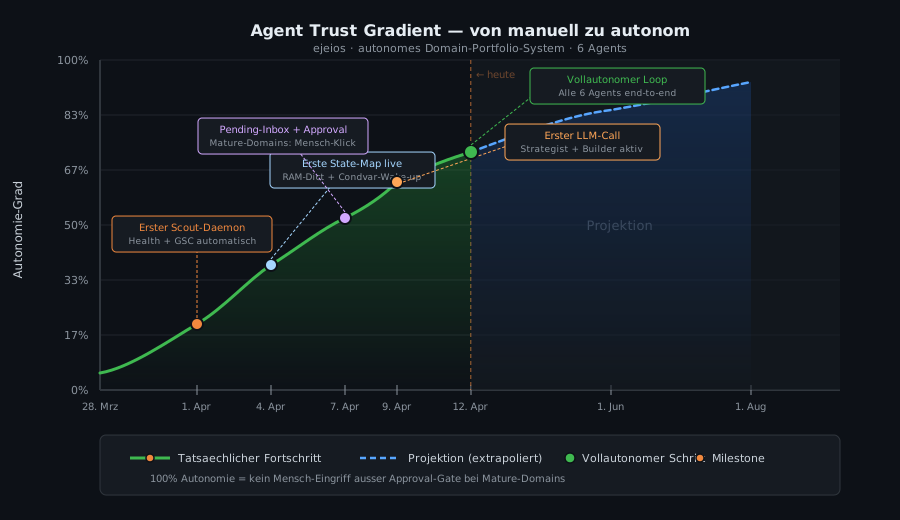
| Date | Milestone | Autonomy |
|---|---|---|
| 28 March | First pages built interactively | 0% |
| 1 April | State-map + daemons running | ~15% |
| 6 April | Overlord closes the loop (B-081) | ~25% |
| 11 April | First LLM call — Strategist, Haiku 4.5 | ~35% |
| 12 April | Sharp Strategist works. Builder incompatible. | ~40% |
| After B-153 | Builder generates content via LLM | ~70% |
| After B-172 | Lifecycle transitions on signals | ~85% |
The gap between “autonomous on paper” and “autonomous in practice” is where most agentic projects live.
Part X: Parallels to the Human System
The body metaphors fit uncomfortably well.
The Overlord is called “Vagus” — the body’s background coordinator. Scout runs at different frequencies depending on domain maturity, like attention shifting with urgency. The three data layers map onto memory systems: L1 is perceptual memory (raw, append-only), L2 is working memory (current, actionable), L3 is episodic memory (patterns over time). And the hardest design problem — when does the system decide alone vs. escalate — is the problem of healthy agency in a human life.
The SOUL document:
“Bei jungen Domains ohne Traffic entscheidet und entwickelt das Kollektiv selbst, ohne Wartepause. Sobald eine Domain reif wird — holt sie vor Deploy eine Freigabe per Klick ein.”
Autonomy is not binary. It’s earned.
Gabor Maté — When the Body Says No: “Kein Organismus baut gerne an seiner eigenen Überflüssigkeit. Der Drang, das Unmittelbare zu lösen, die Seite fertigzustellen — das ist kein Design-Fehler, das ist Dopamin, der das tut, was er immer tut. Die eigentliche Frage ist nicht ‘Warum ist das Werkzeug so?’ sondern ‘Was brauche ich — der Mensch am Keyboard — damit ich mich nicht vom Dopamin des sichtbaren Ergebnisses verführen lasse, wenn der unsichtbare Aufbau das Richtige wäre?’ Das ist keine Prompt-Engineering-Frage. Das ist eine Selbstregulierungs-Frage.”
Part XI: Lessons
1. Write the SOUL document before any code. One paragraph, not a spec — a philosophy. “What is this for? What does it refuse to do?” Ours has been updated nine times. Each update is a decision that couldn’t be resolved by reading code alone.
Peter Thiel — Zero to One: “Every great business is built on a secret — a truth that very few people agree with. ‘Das System beobachtet und nährt — es zwingt nie’ is a secret in exactly this sense. Almost every automation tool forces. This one refuses to. That refusal is not a constraint on what the system does. It’s the definition of what the system is. The fact that this sentence almost got buried under flow diagrams and cadence tables — and then deliberately excavated on the morning of April 10th — is the most important architectural decision in the project. It had nothing to do with code.”
2. Observer first, actor second. Build the dashboard before the agents. Build health checks before deployment. Empty cells in the visualization become the to-do list. The gaps are the spec.
3. Name the boundary, not just the behavior. Write “What I do NOT do” for every agent. Boundaries are not limitations — they’re the conditions under which parallel agents can trust each other.
4. The trigger table must be readable by a non-engineer. If your coordination logic requires codebase familiarity to understand, it’s already too complex to debug at 2am.
5. Explicit interface contracts before parallel development. The Builder-Strategist incompatibility — “No strategy found” — existed because two components were built toward each other without a written contract. The session note says it plainly: “Erst der tatsächliche Crash hat den Interface-Vertrag sichtbar gemacht.” Only the actual crash made the interface contract visible.
6. Name which mode you’re in before each session. (See also: iterative code development as a discipline) Interactive (Claude Code builds things now) or Autonomous (we’re building infrastructure). They require different decisions. Most friction comes from mixing them.
Ray Dalio — Principles: “The psychological trap — the pull toward the interactive timeline because it produces visible satisfaction — is the same trap that keeps most organizations stuck at the level of the person who founded them. Session discipline — declaring which mode you’re in before you begin — is not a productivity trick. It is the only mechanism by which a solo operator can function as the designer of a machine rather than its most productive employee.”
Part XII: What’s Still Broken
B-180: The button that does nothing. Approval UI works. Resolver hook not wired. Clicking “Approve” marks an item resolved. No downstream action fires. The loop runs until you kill the server.
B-153: The Builder without a mind. When dispatched, it runs deterministic template generation. The loop Scout → Strategist → Builder → Inspector → Shipper is wired, but the LLM intelligence is missing from the middle.
The Builder-Strategist interface incompatibility. The old Builder reads strategy-*.json files. The new Strategist writes to the state-map. First contact: crash. The fix is clear — establish the state-map as the single source of truth, remove the file-based path. But it hasn’t happened yet.
Three silent TODOs in overlord_daemon.py. The lifecycle-transition suggestion system is commented out. The Overlord sees when a domain should transition. It cannot say so.
B-143: No rollback. The sharp Shipper deploys to Netcup. There is no automated undo.
Nassim Taleb — The Black Swan: “No rollback. A Shipper that deploys directly to Netcup, without the ability to reverse. The justification: ‘Manual cleanup via SSH is manageable — for now, while there are few domains.’ This is the classic tail-risk mistake: you calculate the expected severity of damage at current scale, not at the scale you intend to reach. At 3 domains, a broken deployment is unpleasant. At 30 domains, it’s systemic. The cost of building a rollback system grows linearly with time — the damage without one grows with the square of the domains. Whoever doesn’t build the brake now, because it doesn’t hurt yet, has confused antifragility with robustness: they have neither.”
The unanswered question that Thiel would flag first: SOUL.md answers six of his seven company-building questions precisely. The seventh — “Do you have a plan to reach customers?” — is absent. The system runs on 30 owned domains. There is no distribution model for selling it to others. A system with perfect technology and no path to external customers is a very sophisticated personal tool. Whether that matters depends on the intention — but the silence is visible.
The unanswered question about LLM scope: What is the right scope for an LLM call? The current Strategist spike sees one domain at a time. Should it see the portfolio as a whole? Should it understand that atme.jetzt and atem.schule are complementary and should cross-link? Deferred. Will matter.
Part XIII: What the Delegation Experiment Revealed
This section was generated through a direct test of the project’s core thesis: does delegation to a specialized agent produce different results than doing the same task yourself?
For this article’s Thiel analysis, two independent analyses ran on the same task: reconstruct SOUL.md’s evolution and identify where Thiel’s framework maps to it.
First pass — mine — started from conversation context built over days. I knew to look for the earliest SOUL.md commits because we’d discussed them explicitly. I found four versions:
$ git show 2402984b:SOUL.md   # V0: March 31 — The Secret. Three paragraphs. Pure philosophy.
$ git show fe9f3cfe:SOUL.md   # V1: April 1  — "Pipeline — Wohin wir wollen." The drift.
$ git show d58bad38:SOUL.md   # V2: April 10, 07:56 — Deliberate reset. "Von Architektur zur Haltung."
$ git show d3cd85d5:SOUL.md   # V3: April 10, 14:54 — Synthesis. "Was bleibt wahr."
Second pass — a fresh agent — had only the git repository and no conversation context. It ran git log -- SOUL.md and found four versions too. But different ones: the agent’s earliest version was d58bad38 — April 10th. V0 and V1 were invisible to it.
Not because they don’t exist in git. They do. But git log -- SOUL.md returns only commits that touched SOUL.md. The April 1st commit message says:
2026-04-01 Domain-State-Map + direnv + SOUL.md
Nothing in that message signals: this commit is where the founding document briefly became a pipeline specification. The agent had no reason to suspect a version where SOUL.md was titled “Pipeline — Wohin wir wollen” — because that fact lives in the content, not in the message.
The drift story was invisible to the agent. The recovery was there. What was being recovered from was not.
What the agent found that I didn’t
L1 as monopoly moat. I framed the append-only design as epistemic humility (Taleb’s frame). The agent added the Thiel frame: it’s also a competitive moat. Every competitor has identical data sources. What’s inimitable is the decision to never overwrite. That’s not a technical choice — it’s an integrity constraint that most builders reject because it feels slow. The moat exists precisely because of that rejection.
The Distribution gap. Thiel asks seven questions. SOUL.md answers six with precision. The seventh — “Do you have a plan to reach customers?” — is absent. The agent flagged this cleanly. I had documented everything else in Thiel’s framework and skipped this one. Not because it isn’t real. Because I had conversation context that understood the scope as a personal portfolio tool. The agent, without that context, saw the gap clearly.
Eight annotation proposals vs. my two. The agent treated Thiel as a running commentary throughout the project — same pattern as Dalio, Maté, Taleb. My instinct was two surgical insertions: Thiel as a capstone voice specifically on the founding document. Both are defensible architectural choices. The difference is editorial: is Thiel’s frame specific to SOUL.md, or is it the lens for the whole project? This article uses the narrower choice — but the agent’s broader reading is not wrong.
What git is — and what it isn’t
| Git IS | Git IS NOT |
|---|---|
| Decision archaeology — complete record of what changed and when | Context — the why lives in commit messages only if you wrote it |
A time machine for any file at any version (git show hash:file) | A substitute for documentation — silence in the message is silence in history |
| Evidence that cannot be revised — L1 for your own decisions | Readable by agents without curation — fresh analysis still requires the right question |
| The only honest record in an agentic project | A spec, a project management tool, or a test suite |
The agent’s missed versions illustrate the last row. Git stored V0 and V1 perfectly. The agent was looking at the right log. The problem was not the tool — it was that reconstructing the significance of a commit requires knowing what to expect. That knowledge lived in the conversation, not the repository.
Commit message best practices — from nine “Korrektur” commits:
The most valuable commits in this project are the corrections. Not because the bugs were interesting — but because someone named what they were correcting:
# Weak — describes action, not intent:
"Update SOUL.md"
"Fix overlord dispatch"
"Refactor state map"

# Strong — describes drift, decision, and correction:
"SOUL.md: Philosophy-Refresh — von Architektur zur Haltung"
"Korrektur: Vision wieder hochgezogen — Approval-Gate ist Brücke, kein Ziel"
"B-156 Folgefix: Portfolio-Lifecycle hat Vorrang beim Bootstrap"
An agent reading the second set can reconstruct intent. Reading the first, it sees only action. The difference is whether your git log is a changelog or a decision record.
How a rewrite would solve this differently
Three structural problems surfaced in this project that a rewrite — informed by the full git history — could eliminate before the first line of implementation code:
1. Interface contracts before parallel development.
# Current (discovered via crash):
# Strategist writes → state_map['domain']['strategist']['last_recommendation'] (string)
# Builder reads → data/{domain}/strategy-YYYY-MM-DD.json (structured JSON with actions[])
# Result: "No strategy found"
A rewrite writes one document — INTERFACES.md — before any agent implementation. What Strategist writes. What Builder reads. Where it lives. The interface contract is version-controlled and reviewed before the first implementation begins.
2. State-map as single source of truth — always.
The portfolio.yaml ↔ state-map sync problem (three bugs in the same axis, B-156, B-164, B-156 Folgefix) exists because two competing sources of truth emerged during development. A rewrite encodes one rule in the project’s SOUL:
Runtime state lives in the state-map. Persistence writes FROM the state-map. Never the reverse.
portfolio.yaml becomes a snapshot, not a source. The rule is architectural, not just conventional — the state-map is initialized from the snapshot at startup, and the snapshot is written by the state-map on shutdown. One direction. Always.
3. Portrait before implementation — enforced.
The moment a daemon exists without a corresponding agents/*.md portrait, it becomes a function rather than an agent. A rewrite enforces this structurally:
agents/
  scout.md        ← exists → scout_daemon.py is an agent
  strategist.md   ← exists → strategist_daemon.py is an agent
  builder.md      ← exists → builder_daemon.py is still a template engine (B-153)
  # overlord.md?  ← missing → overlord_daemon.py is an automation, not an agent
The portrait defines the “Was ich NICHT tue” boundary. Without it, scope creep is structurally allowed. With it, every pull request that adds behavior to a daemon without updating its portrait is visibly incomplete.
The meta-finding
The delegation experiment produced the same conclusion as the project itself: a single intelligence with full context finds things a fresh agent misses. A fresh agent finds things the context-loaded intelligence has stopped seeing. The right answer is not to choose — it is to compare.
The agent missed the V0→V1 drift. I missed the L1 moat framing and the Distribution gap. Combined, the picture is more complete than either analysis alone.
That is not a lesson about AI. It is a lesson about any coordination problem: multiple observers with different vantage points, writing to a shared record, surface more truth than any single observer can.
The State-Map was the right architecture for this project. And it’s the right architecture for building it.
We’re holding two incompatible timelines.
The interactive timeline produces visible results immediately. Pages go live. Commits accumulate. It’s satisfying in the way that cooking a meal is satisfying — you did the thing, there’s the result.
The autonomous timeline requires infrastructure investment before any results are visible. “State-Map Snapshot Dirty-Flag + Throttled Background-Writer” doesn’t look like shipping. But without it, the system loses state on crash or hammers disk on every write.
Infrastructure investment looks, from outside, like no progress. But it’s the only work that compounds. Every page written manually is one page. Every piece of infrastructure built is leverage for every page the system will ever write. That compounding logic is what building machines for continuous evolution actually means.
And the meta-challenge: Claude Code, the tool used to build this infrastructure, has a gravitational pull toward the interactive timeline. It is very good at the immediate, the concrete, the finished thing. It is less naturally inclined to build the plumbing that makes itself unnecessary. That is not a criticism — it’s an honest observation about the shape of the tool. It means being deliberate about which timeline you’re in during any given session. And it means that the most important skill in agentic development might not be prompting or architecture — it might be session discipline.
The autonomous system is almost real. The loop is wired. The agents have identity. The first LLM call worked. The Strategist, when tested live against slowbreath.de, did exactly what the architecture intended: read the state, formulated a SOUL-aligned recommendation, wrote signal_builder=True to the state-map, and the Overlord dispatched the Builder within seconds. No hallucinations, no spec deviation.
Then the Builder crashed with “No strategy found.”
That gap — between “the architecture works” and “all the parts speak the same language” — is smaller than it looks. It just requires the patience to build the plumbing before turning on the tap.
Ray Dalio — Principles: “The dopamine of the finished page is real. So is the compounding of infrastructure. These are not equally valuable, and most people know that intellectually and ignore it behaviorally. Session discipline — declaring which mode you’re in before you begin — is the only mechanism by which a solo operator can function as the designer of a machine rather than its most productive employee.”
Peter Thiel — Zero to One: “Definite optimism is not hope. It is a model of the future that you have reasoned through and are building toward — even when you can’t see the destination from here. Three sentences in SOUL.md will still be true in ten years regardless of how LLMs or SEO change: domains need time, the system does not force, it is a nervous system. That is a founding secret with durability. The question is never whether the system is ready today. The question is whether the model is correct. If the model is correct, the rest is engineering.”
The agents’ portraits live in /agents/. The backlog of open questions is in BACKLOG.yaml. The history of decisions is in:
git log --all --format="%ai|%s" --reverse
Read it from the beginning. You’ll find the architecture you were actually building, not the one you thought you were.
Related: Dopamin as a Service — im Claude Code Fieber · Building Machines for Continuous Evolution · Multi-Operator Controlled Agent Swarms · The Magical Story of Linux and Git · Iterative Code Development: The Git Philosophy